The Bridgeman Art Library Image Search
Image ID STF 241814
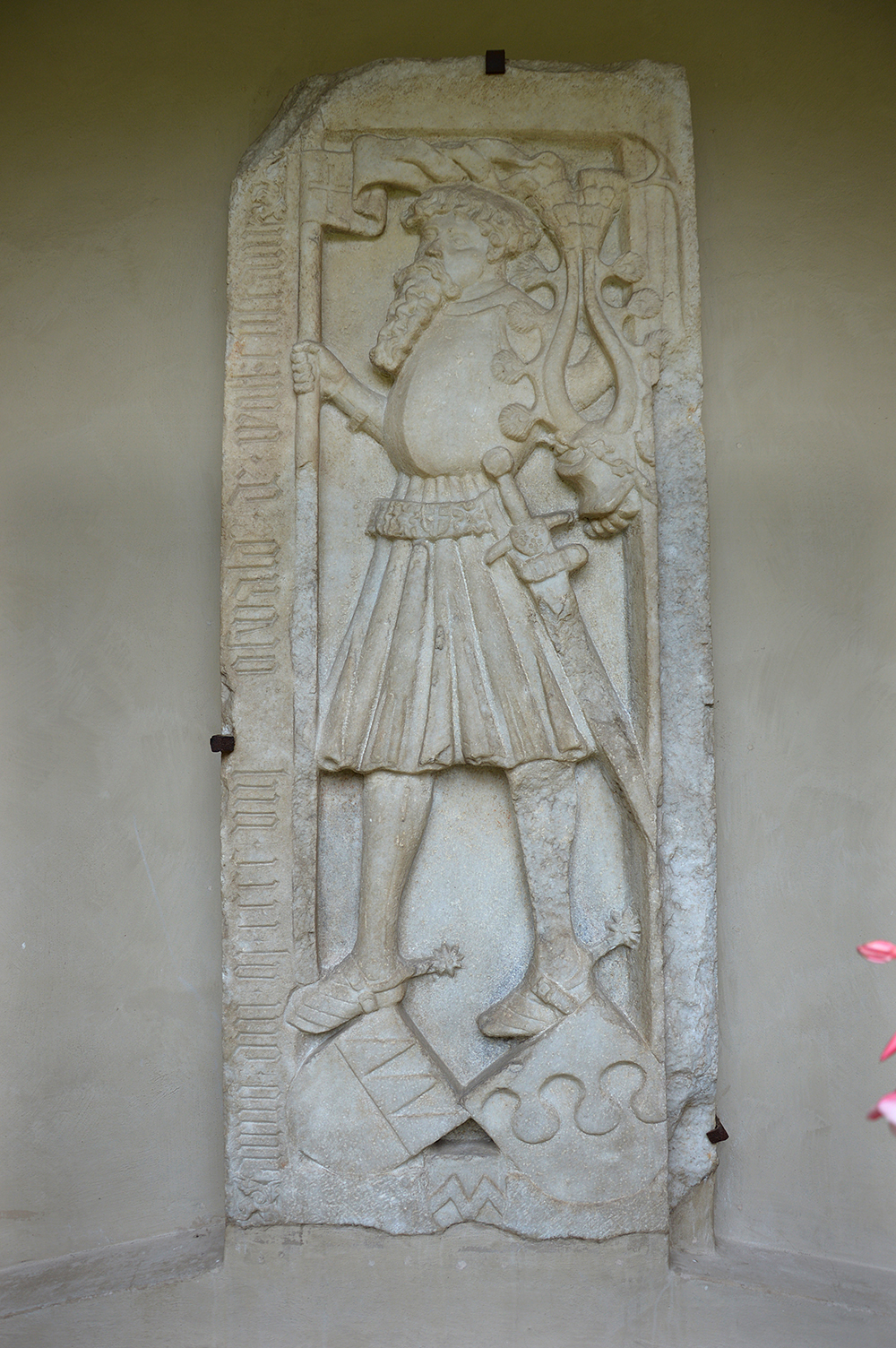
Title Memorial to Oswald von Wolkenstein (1377-1455) 1408 (stone)
Artist Italian School, (15th century)
Location Brixen, South Tyrol, Italy
(Link)
Memorial Slab of Oswald von Wolkenstein, donated on the occasion of his departure for the Holy Land in 1408, Brixen Cathedral
(Image in the Public Domain via Wikimedia Commons)
https://en.wikipedia.org/wiki/Oswald_von_Wolkenstein
Oswald von Wolkenstein (1376 or 1377 in Pfalzen – August 2, 1445, in Meran) was a poet, composer and diplomat. In his diplomatic capacity, he traveled through much of Europe to as far as Georgia (as recounted in "Durch Barbarei, Arabia").
In 1408, in preparation for a pilgrimage to the Holy Land, Oswald paid for a memorial stone to be installed on the wall of the cathedral in Brixen. The stone has survived and shows him in the garb of a Crusader, with the long beard associated with pilgrims.
(Link)
Beim Geschlecht Wolkenstein-Rodenegg (auch Wolkenstein-Rodeneck) handelt es sich um ein Adelsgeschlecht in Tirol, dessen Wurzeln bis in das 12. Jahrhundert zurückreichen. Die Familie Wolkenstein ist eine Seitenlinie der Herren von Villanders. 1293 erwarb die Familie die Burg und das Gericht Wolkenstein, von dem sich der spätere Familienname ableitet. Der Beiname bezieht sich auf Schloss Rodenegg bei Rodeneck, Südtirol.
Das Geschlecht spaltete sich Anfang des 15. Jahrhunderts als Seitenlinie des Geschlechts Wolkenstein-Trostburg ab und geht auf den spätmittelalterlichen Dichterkomponisten Oswald von Wolkenstein (um 1377–1445) zurück, den jüngeren Bruder von Michael von Wolkenstein auf Trostburg († 1443). Oswald selbst besaß allerdings nicht das Schloss Rodenegg, sondern erhielt bei der Erbteilung mit seinen Geschwistern 1407 lediglich einen Dritteil der Burg Hauenstein, die erst 1427 in seinen Alleinbesitz kam. Rodenegg war landesfürstlich, stand jedoch unter der Nutznießung von Oswalds Schwester Martha, verheiratete von Liechtenstein auf Burg Karneid. Mit ihr hatten Oswald und sein Bruder Michael einen Erbstreit, der erst 1425 beigelegt wurde.
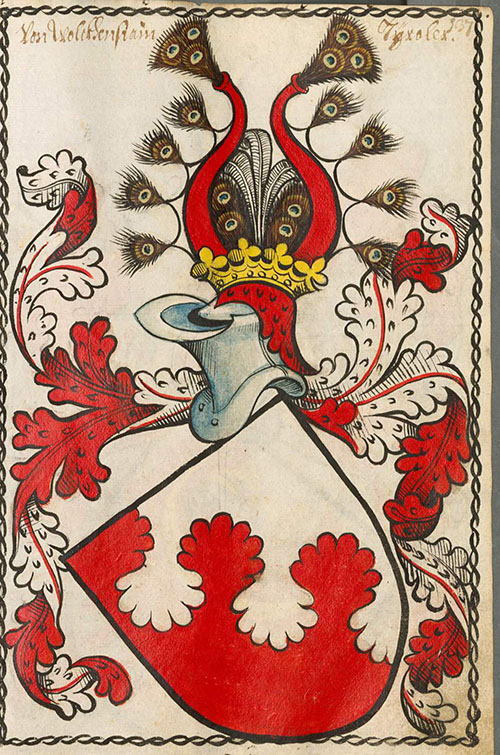
Wappen des Geschlechts Wolkenstein aus dem Scheiblerschen Wappenbuch
(Link)
Wappen von Wolkenstein
Durch die Heirat von Graf Friedrich von Wolkenstein mit Catarina von Villanders wurden beide Wappen zu einem einzigen Wappen zusammengefügt. Es entstand so das heutige Wappen von Wolkenstein
Although a household name in the German-speaking world, he may not be quite as familiar to my international readers. In a nutshell, Oswald was the most important poet writing in the German language during the first half of the 15th century. Although, as most medieval poets, he was actually what today we’d call a singer-songwriter – his verses were set to music and performed by himself. This means that he holds an important position not only in the history of literary, but also in the history of music of that area and era, many of his compositions being based on international models, e.g. works by Francesco Landini or Nicolas Grenon.
As this last note already shows, Oswald had a broad cultural horizon. This is little wonder, considering his biography. He was born around 1377 in the South Tyrol, and, according to some of his later autobiographical poems, he soon became squire to a knight in whose company he travelled through most parts of the then-known world, including not only most of Europe (e.g. Italy, France, Spain), but also Northern Africa and Turkey. His travels continued later in his life: For instance, in 1408 he departed on a pilgrimage the Holy Land, and in 1415 he participated in the Council of Constance as a member of the retinue of Duke Friedrich IV. of Tyrol. There, he changed into the service of Emperor Sigismund of Luxembourg, and subsequently was sent on embassies to England, Scotland, Portugal and, once again, France. During the latter half of his life, Oswald undertook some more traveling, but all in all his activities were concentrated more on his native Tyrol, where he also ran into some major legal and political trouble. Imprisonment, escape, and allegedly punching the bishop of Brixen in the face are some of the highlights in his post-1420 biography. After a long and adventurous life, Oswald passed away in 1445, and was buried in the Abbey of Neustift near Brixen.
В XI веке епископство Бриксен превратилось в независимое княжество и распространило свою власть на большую часть Тироля. Позднее местные светские феодалы потеснили влияние Бриксена в регионе, однако до 1803 года епископство владело значительными территориями в Альпах и входило на правах суверенного государства в состав Священной Римской империи
После завершения Первой мировой войны в соответствии с условиями Сен-Жерменского договора 1919 года Бриксен в составе территории Южного Тироля был передан Италии и по-итальянски стал называться Брессаноне.