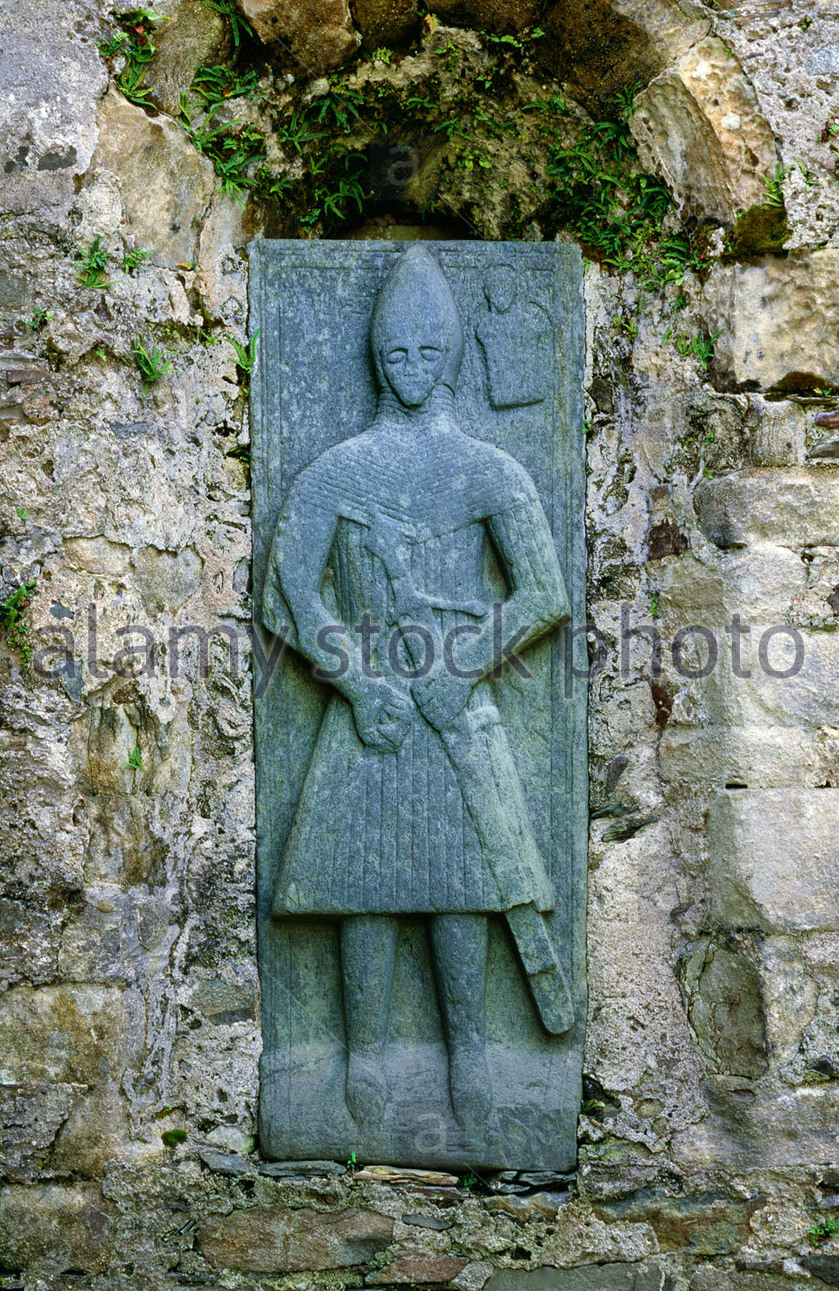
Stone tomb effigy of Scottish highland knight in mediaeval church of Kildalton, island of Islay, Inner Hebrides, Scotland, UK
A slab with an armoured figure in very high relief, built into the south wall, and surrounded by a tall iron railing. No direct sunlight falls upon it, and this made it extremely difficult to photograph. To the left of the head are two lines of writing. The seem to be
HIC JAC ET MARI
To the right of the head is a small figure in a niche, and beneath the elbow on the right of the stone there is a dog.
(Link)
The Kildalton Cross is a monolithic high cross in Celtic cross form in the churchyard of the former parish church of Kildalton (from Scottish Gaelic Cill Daltain, "Church of the Foster Son" (i.e. St John the Evangelist) on the island of Islay in the Inner Hebrides, Scotland.
The cross and the adjacent roofless medieval parish church are in the care of Historic Environment Scotland (access at all times) and are jointly a scheduled ancient monument.
(Link)
The parish is believed to be named after one of the stepsons of the Macdonalds, the family who ruled the island in the Middle Ages. The power of the MacDonalds was tempered by John Mclan (or MacLan) of Ardnamurchan who captured John Mor MacDonald (executed 1499) on behalf of the King James IV. John Maclan's great grandson is buried at Kildalton under a stone bearing an effigy of him in his armour.
(Link)
In the ground within the church and around it are at least seventeen West Highland style recumbent grave slabs, in a range of patterns in common use during the 1300s and 1400s. Especially striking is the grave slab, now set into an interior wall of the church carrying a deeply and beautifully carved effigy of a knight in full regalia with a second smaller figure hovering above his left shoulder. This smaller figure, sometimes found on grave slabs carrying effigies of knights, may be an indication that the knight's wife was buried alonside him.