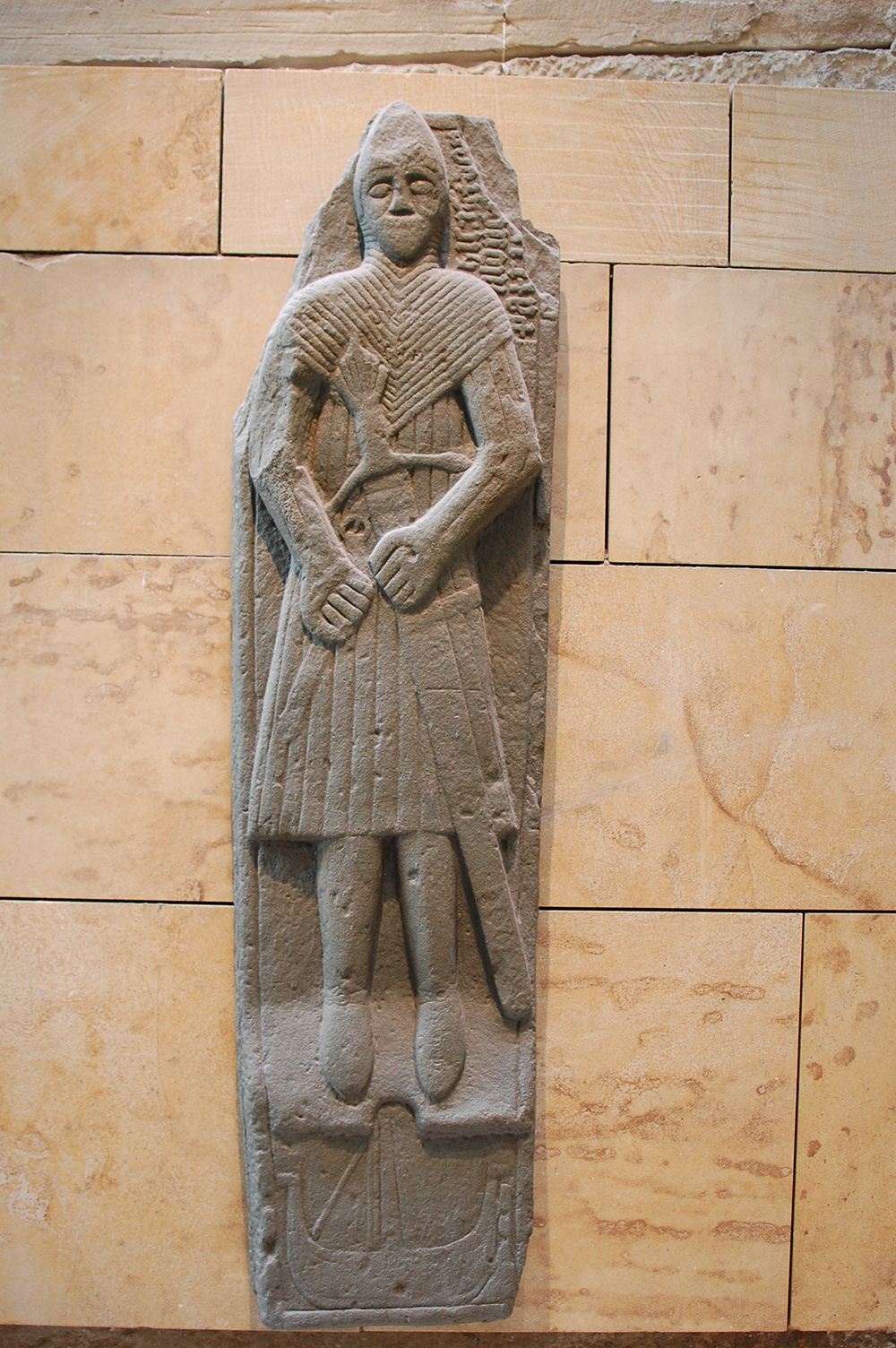
Depicts a Gaelic warrior (with galley in background). Late medieval graveslab of Domhnall Mac Gill'easbuig, from Finlaggan of which this is a cast copy. Museum of Scotland, 2005.
(Link)
Effigy of Domhnall
Mac Gilleasbuig, tenant of Finlaggan in the 1540s
Guerrier gaelique medieval figurant sur un gisant a Finlaggan. Il est originaires des Hebrides, mais en tant que tel est tres proche de ceux de l'Exercitus Scoticanus
Effigy of a man wearing Highland armour
Loch Finlaggan, Islay - the man on the gravestone is said to be Donald MacGill-uisbeag (MacIllaspy) who held Finlaggan in the mid 1500s
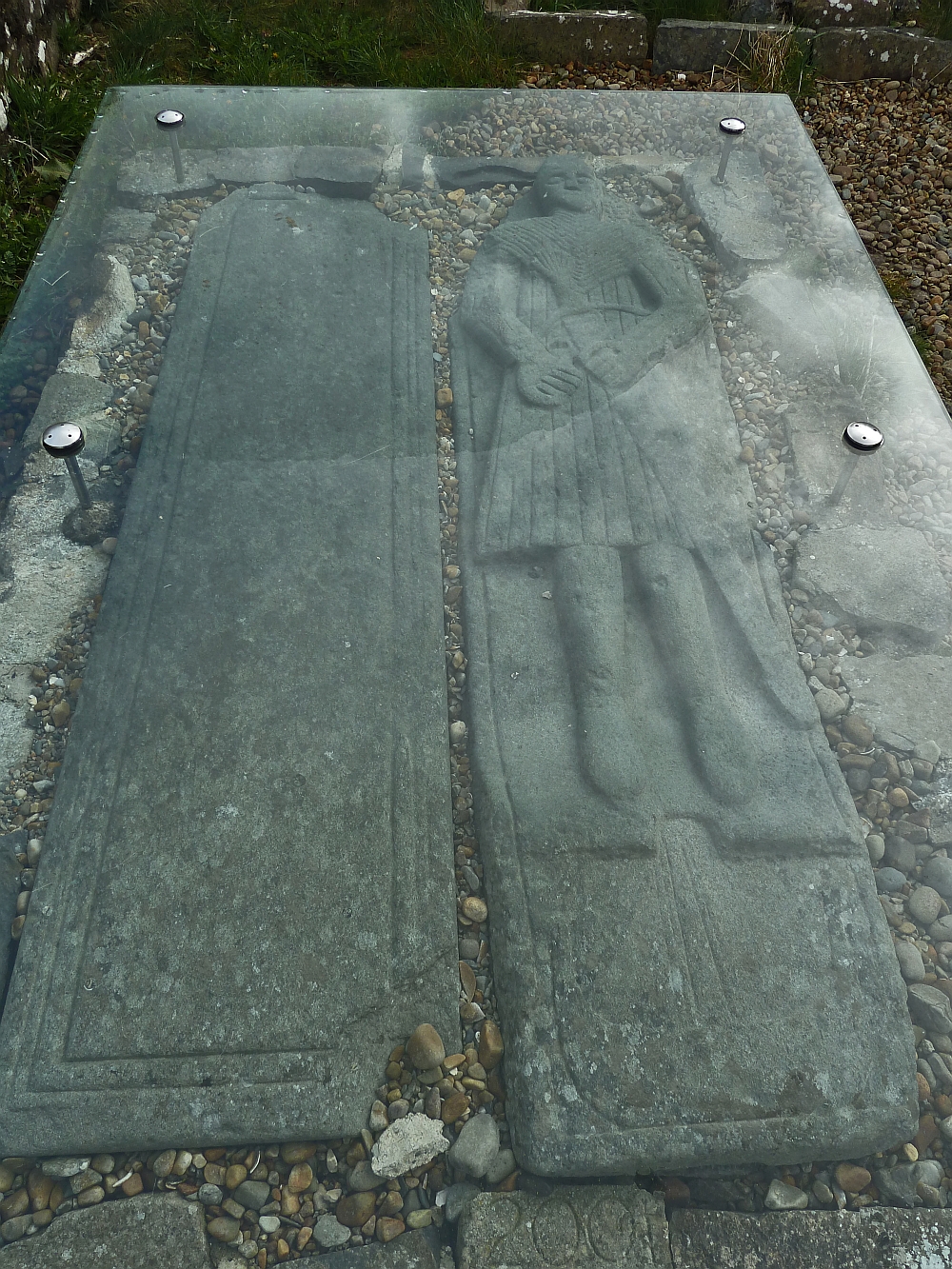
One of these very beautiful and ancient grave slabs represents the effigy of a knight and of his galley… details are given on the information panels below.
Islay Finlaggan Chapel panel © 2015 Scotiana
‘An Caibeal – The Chapel
Straight ahead of you is the ruin of the 14th century chapel built by John I, Lord of the Isles. A carved stone commemorative cros (top left) was discovered in the graveyard next to the chapel. The graveslabs found here include one with an anvil (probably from the grave of a smith), a child’s slab (below left) and a fine effigy of a man in Highland armour (far left) with an image of his galley beneath his feet.
This was Donald MacGill-uisbeag (MacIllaspy) who held Finlaggan in the mid-1500’s.
The chapel was dedicated to St Findluga, a monk who came to Scotland during the 6th century when St Columba was also alive. Recent excavations show that some of the burials in the graveyard are of an earlier date than the chapel.’
National Museum of Scotland
Description Finlaggan Castle, Islay. View of effigy of Donaldus, son of Patricius.
Catalogue Number SC 427378
Scope and Content Detail of effigy in chapel at Finlaggan Castle, Islay, Argyll and Bute Loch Finlaggan lies c.1.5km north-west of Ballygrant on Islay. The remains of a castle and associated buildings occupy two small islands at the north-east end of the loch: Eilean Mor, meaning 'great isle'; and Eilean na Comhairle, meaning 'council isle'. On the north-east side of Eilean Mor lies the remains of a late medieval chapel and burial-ground. Within the chapel, a number of medieval grave-slabs still survive in situ. This tapered slab dates from c.1500-60, and bears an effigy of a man in armour with a sword. Below this is a galley without a sail. To the right of the effigy's head is an inscription commemorating 'Donald, son of Patrick, son of Celestinus'.
Source: RCAHMS contribution to SCRAN.
Finlaggan - Grave slab - Knight
Two of the grave slabs in the ruined C14th chapel at Finlaggan. The righthand one depicting a knight with hefty broadsword.
Knight grave slab for a view beneath the protective lid.
The ancient historical site of Finlaggan lies towards the north of the isle of Islay, the remains of the buildings are clustered on a little islet called Eilean Mor ("Big island" despite its size) with a tiny circular islet, Eilean na Comhairle "council isle" a few dozen yards to its southwest - according to a sign board on the site "The Council Island, reached from here by a stone causeway, was the meeting place for the Council of the Isles. Recent excavations have revealed the ruins of an Iron Age stronghold - a dun or broch - on the island. And at a later date, perhaps in the C13th a castle was built over the ruins of this fort. The castle was dismantled and replaced by buildings occupied in the 1400s, one of which is thought to have been the Council Chamber."
A third island, Eilean Mhuireill lies much further away off the southern end of the eastern coast of the loch. It is a Crannog LinkExternal link and may have once been used by the Clan Donald as a prison island.
Eilean Mor is now linked to mainland Islay by a wooden causeway, but until recently access was only by small boat. Council isle remains detached, as does Eilean Mhuireill.
This group of islands in Loch Finlaggan was the clan headquarters of the Clan Donald, Lords of the Isles, and though the OS map labels the site as a "Castle" it is better thought of as an ancient palace.
Most of the ruined buildings now visible date from the 14th to 16th centuries, but the site dates back much further into antiquity, with its period of greatest importance being in the reign of John, First Lord of the Isles (1329-80), while its history stretches back to at least the Iron Age.
Effigy of Donald M'Gillespie / Gillespy (Domhnall Mac Gilleasbuig), crown tenant of Finlaggan during the 1540s (d. 1562?)
Cast copy of a 16th-century grave effigy from Finlaggan, Museum of Scotland.
Effigy of Domhall (Donald/Domhnall) MacGill'easbuig (M'Gillespie/Gillespy)
Effigy of Donald MacGill'easbuig
A cast of the original, mid-16th century effigy at Finlaggan, where MacGill'easbuig was a crown tenant. He is shown in West Highland armour, implying his status as a mercenary in the wars in Ireland.
National Museums of Scotland