The next oldest portion of this interesting fabric is the east end. As to the age of this there is also good data, for it appears that about 1543,
the church of St Mary of Cullen was converted into a college by Alexander Ogilvy of Deskford and Findlater
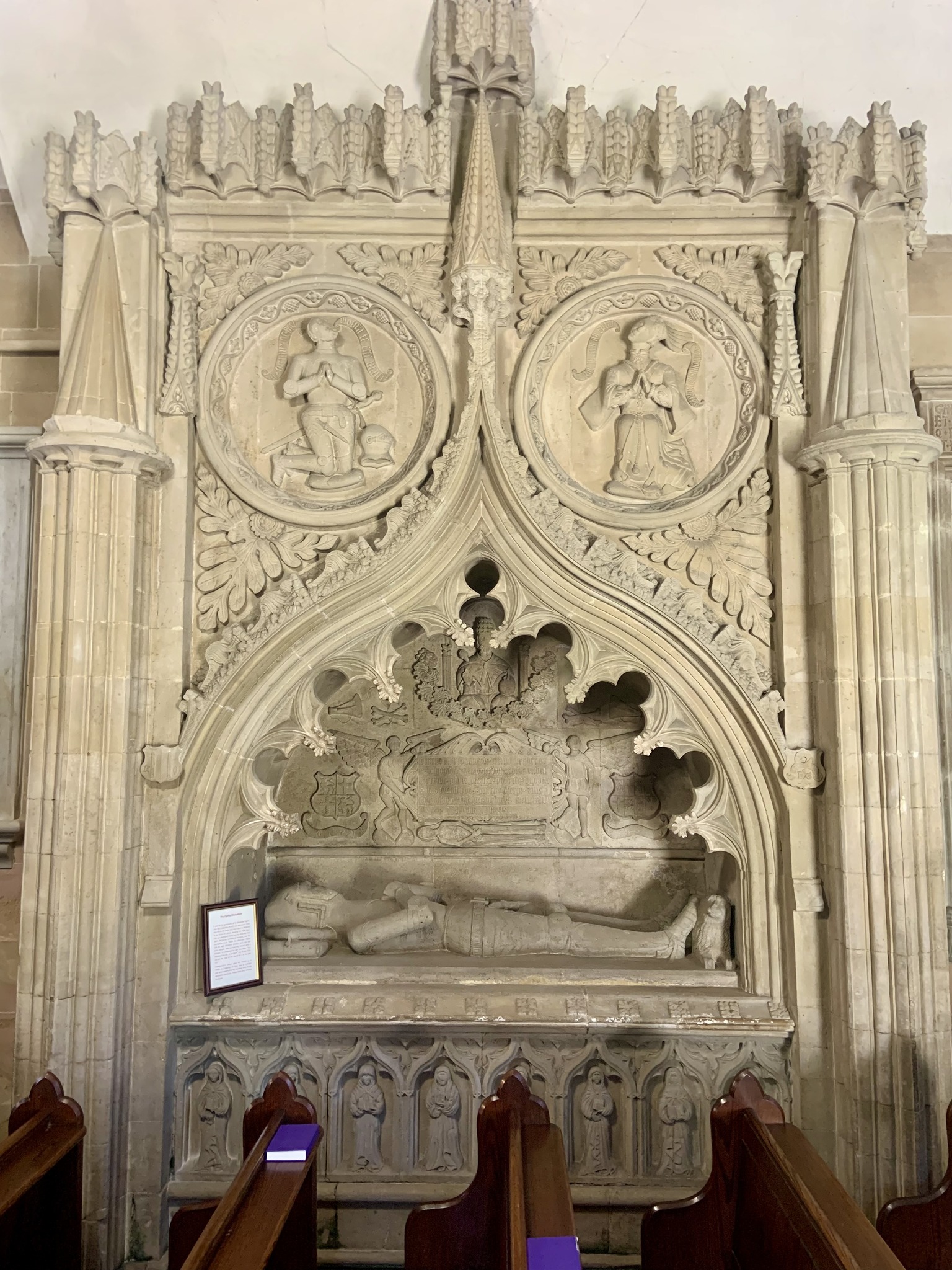
A richly decorated monument, in the Perpendicular style, with canopy, is in the north-east wall of the church. It reaches from the floor to the ceiling, and consists of an arched recess projecting from the wall, enclosing the tomb on three sides. The lower portion is formed of eight panels, each being filled with a figure attired in a hood and long robe, with book in hand. These are popularly believed to represent the " eight innocent boys," for whom, as the following inscription from the tomb shows, Ogilvy and his lady founded the asylum
A stone effigy of Ogilvy lies upon the top, and the above lines are from a slab in the back of the tomb. The lines are surrounded by the Ogilvy and Gordon arms, and a variety of curious and elaborate carving. As a whole, this is possibly one of the finest sepulchral monuments in the north of Scotland ; but, so far as I know, no really good drawing of it has yet been executed, that by Cordiner, though very creditable for the time, is not so correct as could be wished.
(Link)
Tomb of Sir Alexander Ogilvie, St Mary's Collegiate Church, Cullen, Banffshire Already a parish church, St Mary's became collegiate in 1543. Collegiate churches had benefactors, in this case Sir Alexander Ogilvie, who supported priests whose principal duty was to say masses for the souls of the founders and their families. This is the elaborate tomb of Sir Alexander Ogilvie of that Ilk who died in 1554. An armour-clad effigy lies on a tomb-chest under a canopy. The pinnacles above the recess are late Gothic in style but the medallions are early Renaissance in inspiration. The nave and west part of the chancel survive from the original rectangular parish church. The south transept, added in 1536, was endowed by Elena Hay. In 1543 the chancel was lengthened and the north transept was added in 1792.
Here are some photos from the staggering monument attributed to Alexander Ogilvie of Findlater and Deskford in Cullen Old Kirk, Moray, dated 1554. Quite unusual in that the quality of the aumbry is very high and detailed and the effigy within is of a much lower quality, and also quite out-of-date for 1554. Interestingly the figures on the surround seem to have been modelled on the armour of the effigy, but the workmanship is of a much higher quality. I saw about 15 churches and cathedrals on this trip and despite having read about armour development in Scotland being somewhat slower/behind England, I think it is fair to say that this older Ogilvie has been re-cycled for use with this 1554 monument. Obviously just my opinion, but it would make sense of the disparity in quality and dates.
.jpg)
