(Link)
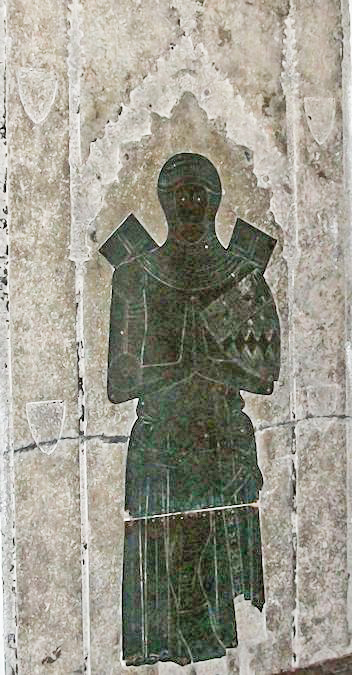
here is but one brass remaining after Dowsing's activities and this, somewhat mutilated, was returned to the Church in a remarkable manner. This is the well known Bacon Brass, an effigy of a cross legged knight. The Bacons were Lords of the Manor some seven centuries ago and the brass is probably a portrait of Sir John who is mentioned in the Inquisition Rolls of 1292. The figure had been torn from its stone matrix and had been considered destroyed, until it was discovered in a collection which was sold in 1830. Mr J. G. Rokewode purchased it and returned it to Gorleston Church where, at the expense of Mr. Dawson Turner, it was restored to its stone and placed vertically on the North wall of the Lady Chapel.
Bacon, Sir Henry, English Knight (c.1335).
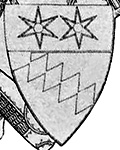
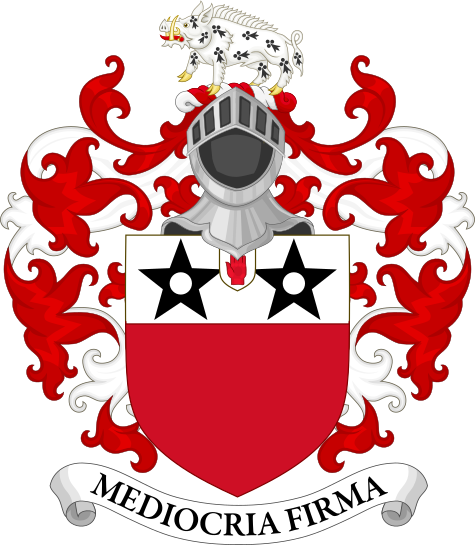
Arms: Gules, a bend lozengy Sable, on a chief Argent, two spur rowels of the second.
(Tomb Effigy, Gorleston Church, co. Suffolk).
(Link)
My favourite part of this church is the Lady(north)chapel. It has a fine wooden reredos, and attached to it's north wall is a late C13 Brass for Sir John Bacon. This disappeared at the time the iconoclast William Dowsing and his men ransacked the churches of all their imagery – 200 years later the brass was found in a private collection and was returned to it's rightful place in this church
(Link)
Member of the Bacon family, Gorleston, Suffolk, early fourteenth century
The problem of dating the effigy arises for two reasons. The first is that the brass was manifestly not engraved by the workshops responsible for the other comparable armoured figures. The figure is less boldly engraved and the design, while similar, seems weak in comparison. The use of plate armour suggests a date similar to that of Sir William Fitzralph at Pebmarsh in Essex, now thought to date from 1331-8, as does the use of strips of brass for the marginal inscription. Sir William's armour differs in that he has plates protecting the upper surface of his feet, which it is known from old drawings that Bacon did not. Bacon's ailettes are rectangular rather than round and his smaller shield is supported by a much less substantial shoulder strap.
Sally Badham came to the conclusion that the brass represented John Bacon, son of Sabine. He probably died shortly after 1304. She recognised that the armour and marginal inscription counted against this view but argued that they were not conclusively negative as they represented nothing that could not be paralleled at around 1305. She assigned the brass to the Ashford series, a series attributed to master Ralph, a marbler working producing incised slabs and brasses between c. 1273 and c. 1308. Claude Blair did not accept her arguments and favoured a date in the 1330s because of the armour and the English tendency to lag behind continental Europe in the armour they favoured both on the battlefield and on the effigies that commemorated them.
The brass was sold to a brazier in the late eighteenth century but rescued and returned to the church around 1830, when the slab was placed upright in the chancel.
There is but one brass remaining after Dowsing's activities and this, somewhat mutilated, was returned to the Church in a remarkable manner. This is the well known Bacon Brass, an effigy of a cross legged knight. The Bacons were Lords of the Manor some seven centuries ago and the brass is probably a portrait of Sir John who is mentioned in the Inquisition Rolls of 1292. The figure had been torn from its stone matrix and had been considered destroyed, until it was discovered in a collection which was sold in 1830. Mr J. G. Rokewode purchased it and returned it to Gorleston Church where, at the expense of Mr. Dawson Turner, it was restored to its stone and placed vertically on the North wall of the Lady Chapel.
(Link)
The cross-legged effigy of a knight, bearing the same armorial cognizance, and represented in the opposite engraving, occupied the matrix of a second of these slabs.
The figure had long been lost, when this church was first visited by the writer, and considered irrecoverable, but was unexpectedly discovered amidst the collection of sepulchral brasses sold after the death of Craven Ord, Esq., in 1830. It was then purchased by the late John Gage Rokewode, Esq., who laudably restored it to the church from which it had been sacrilegiously abstracted. By the care, and, I believe, at the expense of Dawson Turner, Esq., of Yarmouth, it was refixed in its original matrix, and the stone to which it is attached, having been removed from the Bacon chantry, is now placed vertically against the north wall of the chancel, not far from the founder's tomb—a situation selected to preserve it from further injury. The figure is, unfortunately, broken at the lower extremities, but when entire measured five feet six inches in height, and is placed under a canopy supported by buttresses, all of the fashion of the reign of Edward I.; the brass inlays of which are also reaved. Blomefield, in his Church Notes, mentions that the feet of this figure rested on a boar's head, and adds, "I take this to be of the Bacon family, notwithstanding the bendlet lozenge, as also from the stone which joins to the former, under which lies Jane Bacun." No doubt, I think, can be entertained but that this effigy represents John Bacon, mentioned in the Inquisition Rolls of 1292. The whole design and contour of the monument agree perfectly with this date.
(Link)
THE AUSTIN FRIARS OF YARMOUTH
Although the house of these Austin Friars was across the water in Suffolk, in the parish of Gorleston, as it stood in Little Yarmouth or Southtown, mention had better be made of it in this place as well as under the religious houses of Suffolk. In several wills, bequests were made to the four orders of friars of Yarmouth; but Gorleston was not formally joined to the borough until 1688
In the large and handsome church many distinguished persons were buried. Weever names the founder and his wife; Richard earl of Clare; Roger FitzOsbert and Katharine his wife; Sir Henry Bacon, 1335, and many of his family
The church in which the brass stands is a chapel of ease in South town, near Yarmouth and is dedicated to St Mary. Originally the settlement of South town was independent, but in the 16th century it was united with Gorleston and Southtown's parish church was demolished.
разные авторы приписывают памятник разным представителям семьи de Bacon, но мне наиболее обоснованным кажется мнение Claude Blair, что здесь изображен Henry de Bacon (+1335)
никакой генеалогии об этом персонаже не найдено, никаких упоминаний о семье Bacon в районе Yarmouth не найдено