Sir Edmund and Lady Joan de Thorp
All Saints, Ashwellthorpe, Norfolk
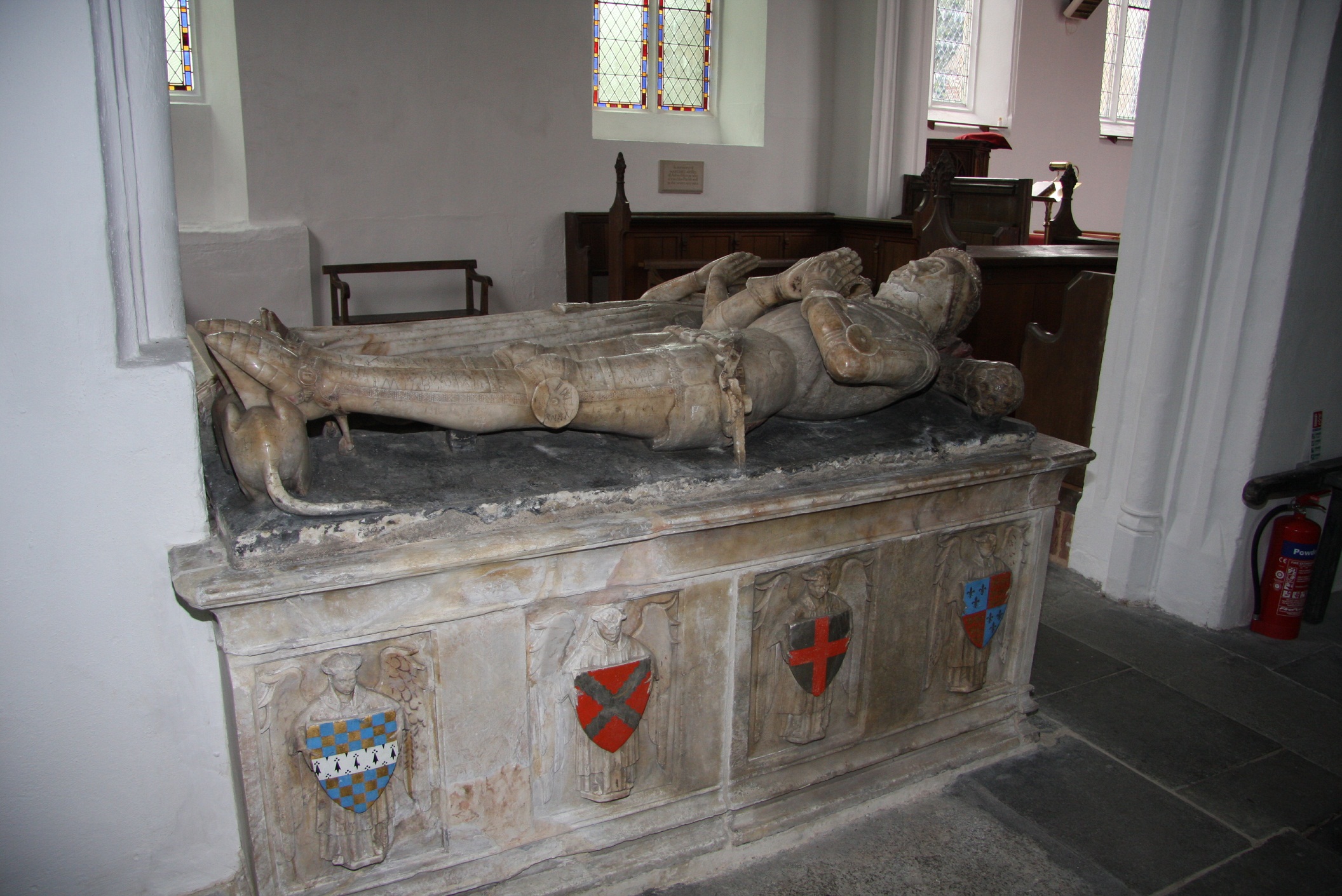
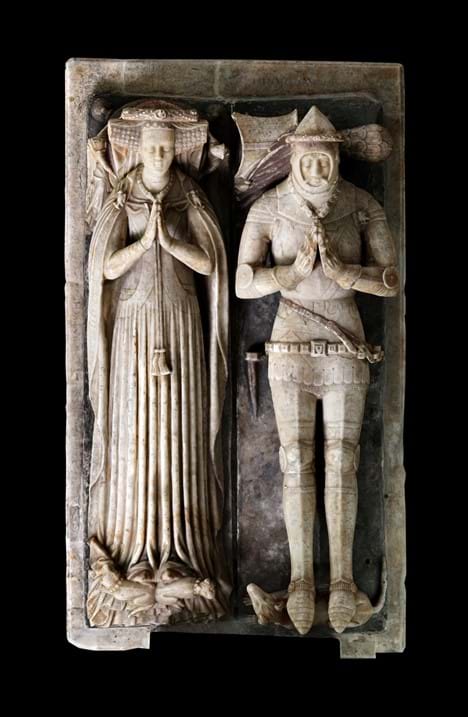
An adornment of this otherwise rather run-of-the-mill church is the fabulous alabaster memorial to Sir Edmund Thorp and his wife Joan. He died at the siege of Louviers in Normandy in 1417. Both of them wear the collar of S's.
(Link)
Museum number 1883,0714.645
Description Effigies of Sir Edmund de Thorpe and Lady, in Ashwelthorpe Church. Norfolk, study for plate 112 of Stothard's 'The Monumental Effigies of Great Britain', published by Mrs Anna Eliza Bray, 1817-32, one of a large group of studies for this volume; both turned to front, with hands held in attitude of prayer, female figure at left, with hair confined by a fret, and resting feet on two dogs, male figure at r, wearing armour, and surcoat bearing arms of Thorpe and Baynard, and resting head on a helmet and feet on a dog
Graphite and brush and grey ink
Drawn by: Charles Alfred Stothard
School/style British
Date 1787-1821
Materials paper
Technique drawn term details
Dimensions Height: 252 millimetres Width: 188 millimetres
Inscribed: "Plate 1" Verso inscribed: "Sir Edmund de Thorpe & Lady Ashwelthorpe Norfolk" On backing sheet numbered: "114"
Location Not on display (British Unmounted Roy PV)
Acquisition name Bequeathed by: Anna Eliza Bray
Acquisition date 1883
Department Prints & Drawings
Registration number 1883,0714.645
A brief history of Sir Edmund from "Burkes Extinct Peerage"
EDMUND (DE THORPE), LORD THORPE, son and heir, was never summoned to parliament, but was knight of the shire for Norfolk 1397-98 and 1407. He was Commer. of array, Mar 1392, to enquire into the wastage of lands,1400, and de walliis et Fossatis, 1408, all in Norfolk. Being retained to stay with the king for life, he was granted a pension of 50 marks p.a. 7 Jan 1392/3, increased to 100 marks by Henry IV, 22 Nov. and 6 Dec. 1399, out of the issues of the town of Kings Lynn, and was confirmed by Henry V, 30 Sep 1413. In Spr 1399 he has protection, going with Richard II on his disastrous journey to Ireland. Having accompanied Henry V to France in 1417 (with 10 Lances and 33 archers), he was appointed Commr. of Array there, 27 Oct 1417, and a Commr. to redress infractions of truce between the king and Duke of Burgundy, 28 Apr 1418.
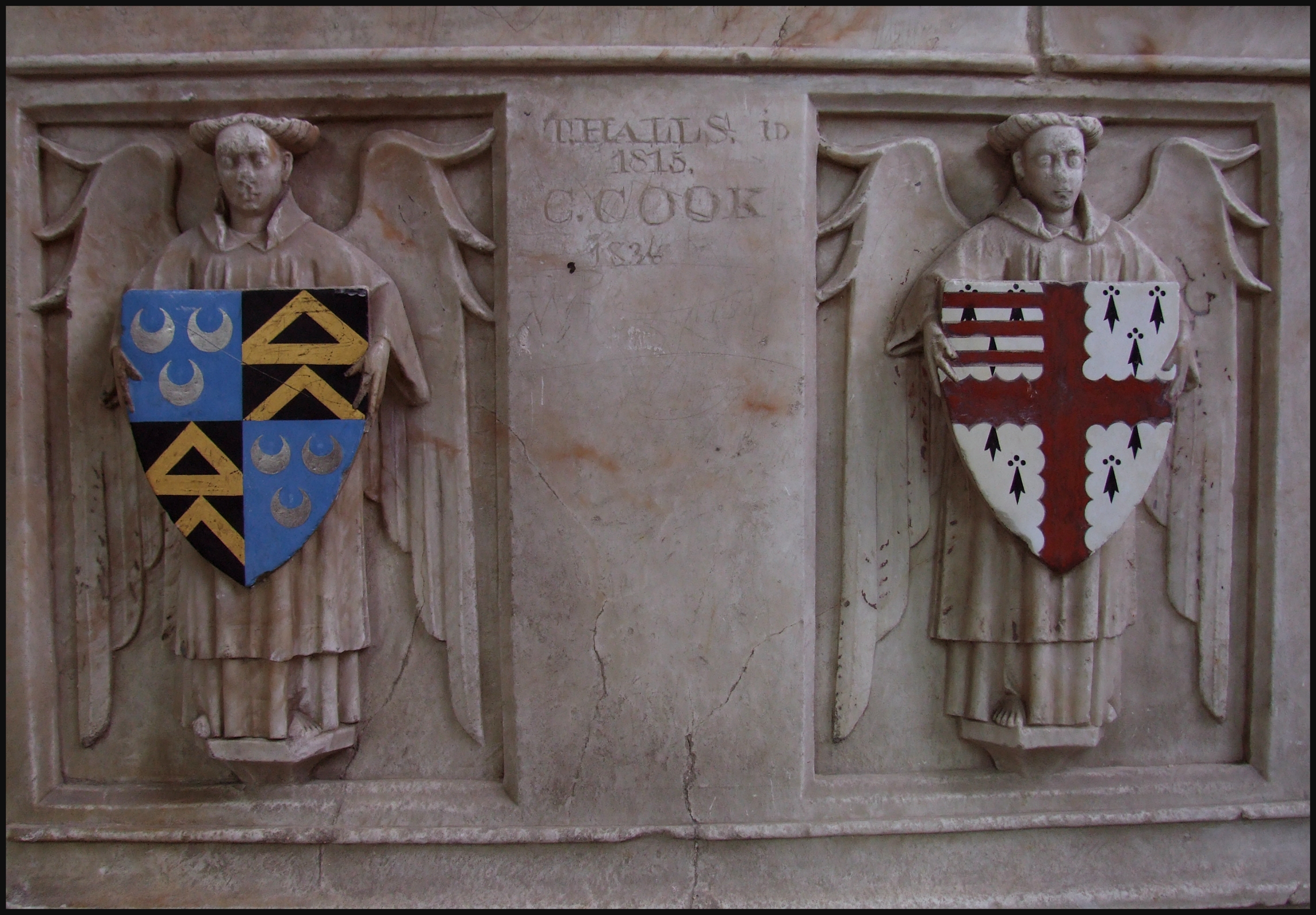
He is said to have married, Firstly, 6 Oct 1368, Margaret, daughter of Richard DE LA RIVERE. He then married? Secondly, between 28 July 1387 and 3 March 1387/8, Joan widow of Roger (DE SCALES), 4th Lord Scales (who died 25 Dec 1386), daughter of John DE NORTHWOOD She died 3 Jan 1414/5 and was buried as Ashwellthorpe. Will dated 29 Sep 1414,pr. 21 Apr 1415. he is said to have died at the Siege of Louviers (June 1418) in Normandy and he certainly died . s.p.m. before 31 Aug 1422 (i.e in the lifetime of Henry V) being buried at Ashwellthorpe ( His effigy there in full armour, and that of his wife, of white alabaster, lie under a wooden canopy, The arms quartered on his tomb, including Thorpe, Baynard, Northwood, Clifton, Barrey, Kerdeston and Calthorp). At his death the barony of Thorpe (of the assumption that it existed) fell, according to modern doctrine, into abeyance between his 2 daughters and coheirs by his 2nd wife :- (i) Joan, married Firstly Sir Robert ECHINGHAM, and Secondly, Sir John CLIFTON, of Old Buckingham, Norfolk, who died 1447. She survived him, but died s.p.s. (ii) Isabel, married Philip TYLNEY and died 10 Nov 1436, being buried at Ashwellthorpe.
The de Thorp Tomb, Ashwellthorpe
The alabaster tomb bearing the effigies of Sir Edmund de Thorp and his second wife Joan – daughter of Sir Robert de Northwood and widow of Lord Scales – lies within All Saints Church, Ashwellthorpe. Lords of the Manor, the de Thorp family – by children, marriages, kinsmen – passed on this manorial lordship right through to the mid-20th Century.
Sir Edmund was the son of another Sir Edmund de Thorp and his wife Joan nee Baynard. Sir Edmund was killed in 1418 during the siege of the castle in Louvier, Normandy, where he had been one of King Henry V's men and his body was brought back to Ashwellthorpe for burial in his Chapel. He had the Chapel – Thorp Chapel – added to the north of the Chancel in 1393 to become his eventual burial place. This pre-Reformation tomb is one of only two remaining in Norfolk and lies between the Chancel and Thorp Chapel. Originally under a wooden canopy, the white alabaster effigies lie on the alabaster tomb chest; Sir Edmund in full armour with his helm[et] under his head, his wife lying beside him, a pillow under her head supported by Angels. The west end of the tomb chest is now of stone rather than alabaster and over three centuries, graffiti of names and initials have been carved into the alabaster.
The recent problems with the tomb's foundations have seen it slipping into a void and, without repair work, it could have crumbled and broken up. Restoration in 1967, funded by the Pilgrim Trust, resulted in a thorough cleaning of the tomb and the repainting of the eight heraldic shields around its base. As Humphrey tells us above, funds have been raised and repair work is about to start with stability and restoration completed by Easter 2007.