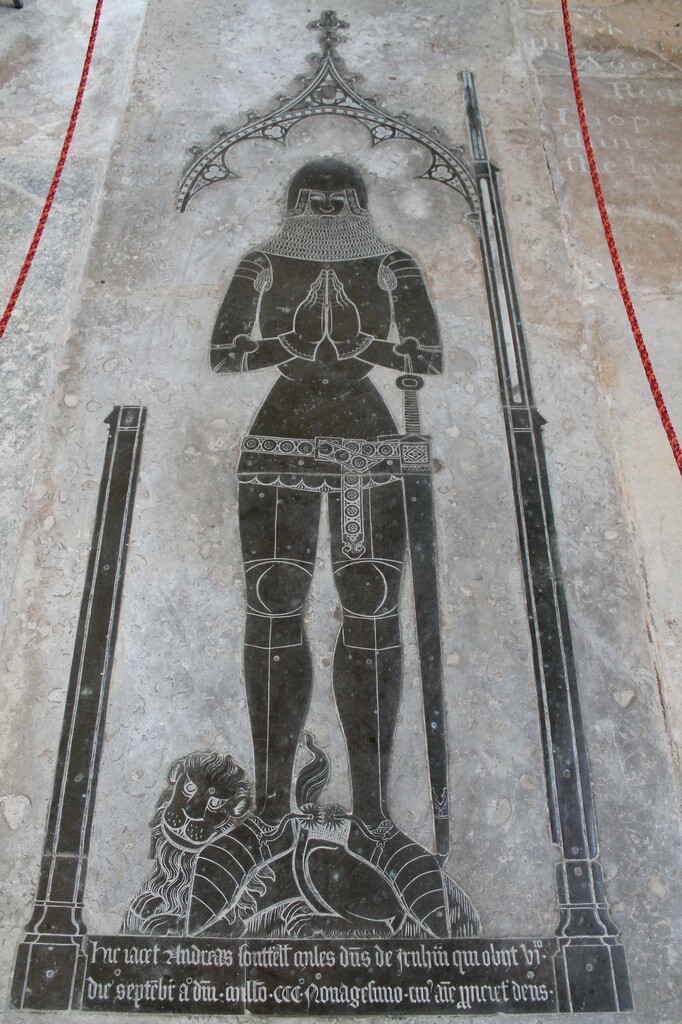
Brass Rubbing: Sir Andrew Loutterell (1982.05.0108)
Artist/Maker Kathleen H. Cairns
Geographic Location Europe, West; United Kingdom of Great Britain and Northern Ireland, England; Lincolnshire; Irnham
Period/Date Medieval; 1390 CE
Dimension 1 (Length) 245.5 cm
Dimension 2 (Width) 89.0 cm
Dimension 3 (Depth) 1.0 cm
Published Description From the catalogue, An Exhibition of Medieval Brass Rubbings by Kathleen H. Cairns. "Sir Andrew Loutterell, 1390, Lord of Irnham. In camail armor. Mutilated canopy. INSCRIPTION: Here lies Andrew Loutterell, knight, Lord of Irnham who died on 6th day of September in the year of our Lord 1390, on whose soul may God have mercy."
A rubbing in the collection of the Ashmolean Museum, Oxford, described as "in 2 halves" and assigned the same date, may be from the same brass.
Bibliography Cairns, Kathleen H. An Exhibition of Medieval Brass Rubbings, December 7, 1969 through January 4, 1970. Frick Fine Arts Building, University of Pittsburgh. Catalog #55.
Rubbed 7 July 1969 (Cairns rubbing diary)
Irnham, Saint Andrew, North Chapel, Brass
"In the north chapel a handsome brass to Sir Andrew Luttrell, d.1390.
Depicting deceased life-sized beneath a cusped ogee canopy, wearing plate armour with feet on a lion and inscription at the base"
(Link)
He was the son of Sir Geoffrey Luttrell, who commissioned the Luttrell Psalter, one of the most famous medieval manuscripts because of its rich illustrations of everyday life in the 14th century.
(Link)https://www.bl.uk/collection-items/the-luttrell-psalter
(Link)
Andrew Luttrell, died 1390
Irnham
(Link)
Sir Andrew Luttrell
1390
St Andrew's Church, Irnham, Lincolnshire, England
(Link)
Sir Andrew Luttrell
1390
Irnham, Lincolnshire
Style: London B
The brass of Sir Andrew Luttrell lies towards the east end of the north aisle of the church of St Andrew at Irnham in the south-west corner of Lincolnshire. He has a London B effigy in armour. The canopy is no longer complete but the rivet pattern on the original slab, which rests against the nearby north wall, shows that the side shafts rose as high as the crockets above the centre of the canopy. His inscription is simple:
Hic iacet Andreas Louttrell miles d[omi]n[u]s de Irnh[a]m qui obijt vjt°die Septe[m]br[is] a[nn]° d[omi]ni . mill[esim]o . CCC . Nonagesimo . cui[us] a[n]i[m]e p[ro]piciet[ur] deus
Here lies Andrew Luttrell, knight, lord of Irnham, who died on the 6th day of September in the year of our Lord a thousand three hundred and ninety, on whose soul God have mercy
(Link)
Brass monument to Sir Andrew Luttrell, Irnham Church, Lincolnshire (1390). From: Cambridge Camden Society (1846) Illustrations of monumental brasses, Cambridge: J.T. Walters
Date 31 December 1846
Source https://archive.org/details/illustrationsofm00camb
Author Cambridge Camden Society
(Link)
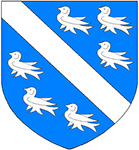
Arms of Luttrell differenced by tincture: left: Azure, a bend between six martlets argent (Luttrell of Irnham, as shown in the Luttrell Psalter)