St Andrew, Dalton-le-Dale, Durham
In the nave is a tomb recess with the effigy of a lady – badly preserved. Above this are raised Roman numerals on the wall – supposedly a sundial that operates on one day of the year when sunlight comes through the windows at the right angle.
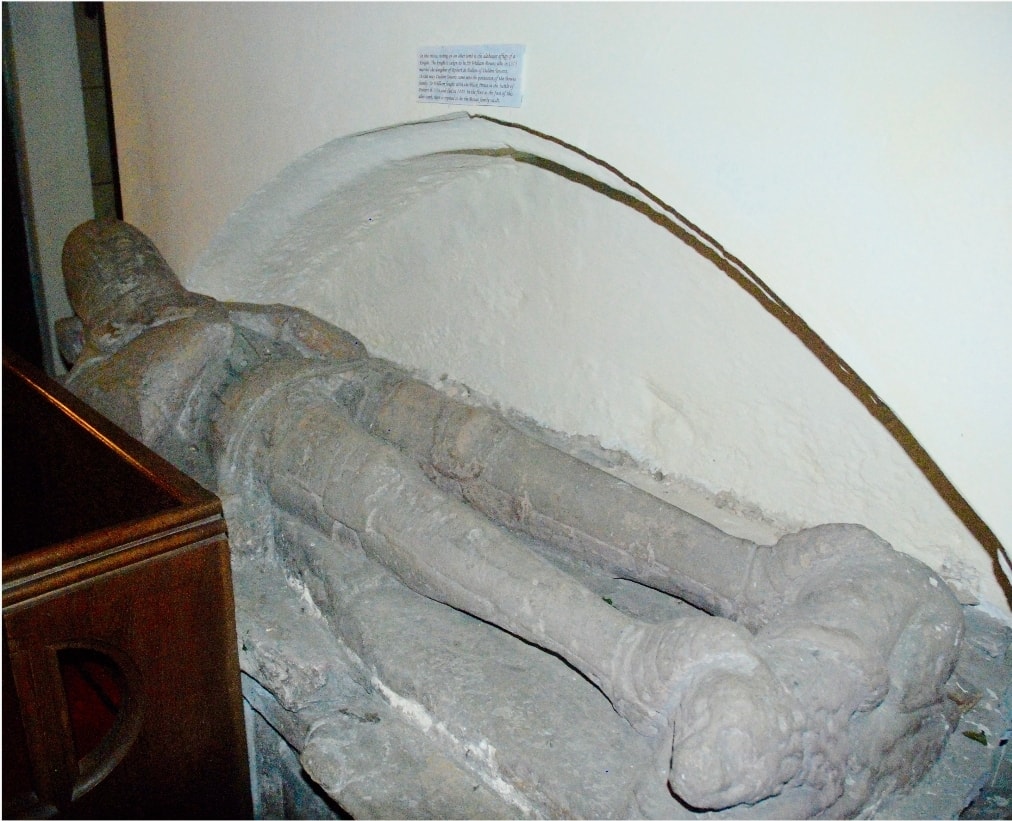
In the chancel are two tombs, one a plain tomb chest with no inscription and the other a tomb chest with a knight on it. He’s better preserved than the lady. A couple of other wall tablets complete the ensemble.
Sir William Bowes
St Andrew's Church, Dalton-le-Dale, Durham
Dalton-le-Dale, Durham
St Andrew
The effigy of a member of the Bowes family in the church of Dalton-le-Dale, Co. Durham, showing the tight-waisted jupon
William Bowes (1420)
(Link)
Sir William Bowes
1420
St Andrew's Church, Dalton-le-Dale, Durham, England
(Link)
St. Andrews Church - Internal Features
Sir William Bowes
Here lies the effigy of Sir William Bowes – Knight of Streatlam near Barnard Castle, who fought with the Black Prince at Poitiers in 1356 and died in 1420. He and his wife Lady Maud owned Dalton Towers and his ancestors eventually married into the Lyon family of Glamis, Scotland the birthplace of the late Queen Mother
(Link)
The Effigy of Sir William Bowes - Knight The Bishopric of Durham from 1314 was subject to continual raids by the Scots, requiring a Peel Tower to be built at Dalden for protection against the invading hordes. Maude, Lady of Dalden (Towers) inherited her father’s estate, when she was fourteen, in 1370, She married Sir William Bowes, Knight of Streatlam, near Barnard Castle, in 1375. He had fought with the Black Prince at the Battle of Poitiers, in 1356 and was created a Knight Banneret for his valour. The English archer's superiority at this time, with the hail of arrows from their longbows, broke the many French attacks who were routed, with their King taken captive. Sir William died in 1420, his coat of arms has three red longbows and his effigy in church is dressed as a Knight with his feet resting on a lion.
(Link)
Archaeologia Aeliana, Or, Miscellaneous Tracts Relating to Antiquity, Том 23. 1899
The present altar tomb was constructed, either for the husband of the testatrix, Sir William Bowes, knight, or for her son, Sir Robert Bowes, knight, who was slain at the battle of Baugy Bridge, in 1421, the year after the making of the will (of Matilda, wife of William del Bowes, 1420), and is still in good preservation. Most probably, however, it was for the latter (Robert).