From Bontell:
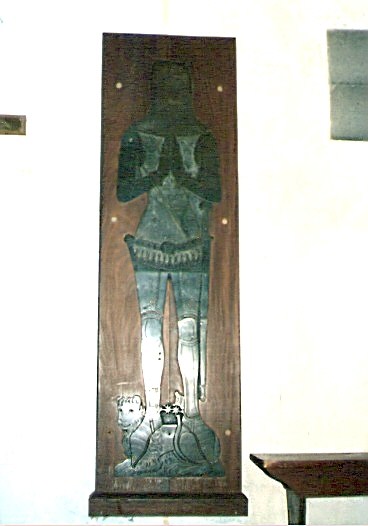
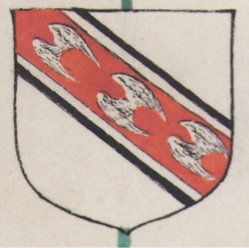
Upon this knight's jupon are emblazoned his arms,—argent on a bend, gules, between three cotises, sable, as many pairs of wings, joined in leure, of the field. This brass is now affixed to the wall, and its original inscription is lost: but Gough gives an inscription from a brass at Letheringham which probably belongs to this effigy: it is in these words:—HIC. IACET. DNS. JOHES. DE WYNGEFELD. MILES. QUONDA. DNS. DE LETHERINGM. AN.... There is also in Gough an impression of a shield, bearing WINGFIELD impaling HASTINGS—Sir John having marries Margaret, daughter of Sir Hugh Hastings. This Sir John Wingfield died 1389
Sir John's mother was Margaret, the heiress of the Bovile family, who married Sir Thomas Wingfield. The greater part of the indent of the brass to Sir Thomas and Margaret now lies at the west end of the nave, under the tower opening, while the indent of Sir John's brass is immediately east of it. Although Sir John's wife, Margaret, daughter of Sir Hugh Hastings, is known to have had her own brass, no trace of it is apparent. Sir John outlived his father by eleven years only, during part of which time he was MP for Suffolk.
His son, Sir Robert, married Elizabeth, daughter of Sir John Russell of Strensham in Worcestershire and there is a striking resemblance between the brasses of Sir John Wingfield and of Robert Russell at Strensham, suggesting that the order for one led to the order for the second. As Sir John Russell married Sir John Wingfield's widow Margaret and died at Letheringham in 1405, this would not be not surprising. The brasses both belong to the style known as London A. While the designs are very similar, the execution differs, suggesting that they were engraved by different marblers. On Sir John's figure, the areas beneath his armpits and below his left arm are hatched, as are the areas between his sword and his leg, while on Robert's figure, they are all cut away so that the stone shows through. The area above the lion between Sir John's ankles is also hatched but left plain on Robert's.
(Link)
(Link)
(Link)